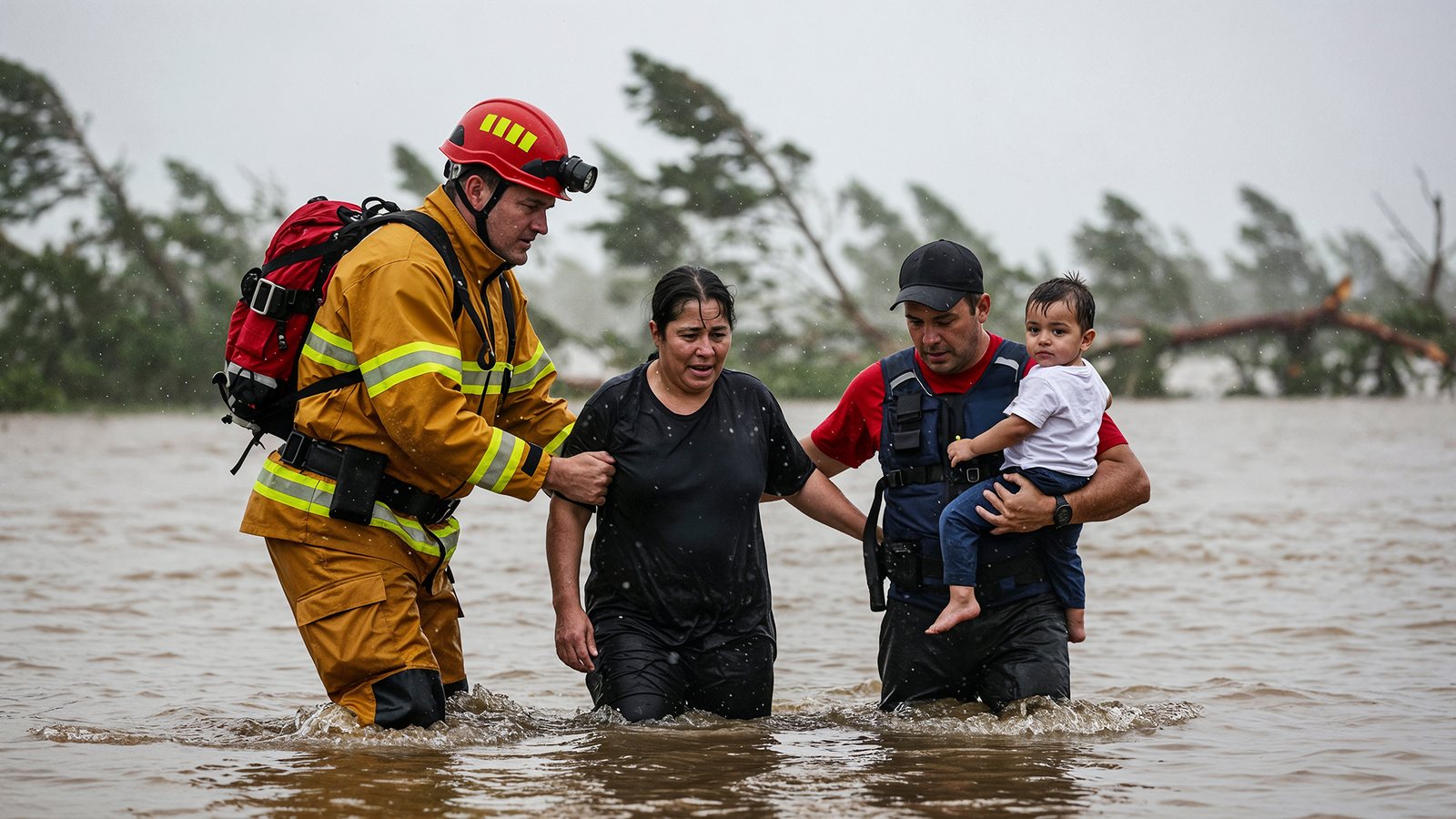
What the $1.3 billion October announcement reveals about the new federal role.
Executive summary
On October 22, 2026, the Federal Emergency Management Agency made two announcements on the same day. It awarded more than $896 million for more than 620 disaster recovery and resilience projects nationwide. It also opened a $400 million Flood Mitigation Assistance funding opportunity for states, territories, tribal nations and the District of Columbia. Together, roughly $1.3 billion, they give the clearest single picture yet of how FEMA is responding to disasters in 2026.
The announcements show an agency doing three things at once. It is moving recovery money at scale through the reimbursement system that has defined federal disaster aid for decades. It is funding mitigation: elevating homes, buying out flood-prone properties and fixing drainage, the work that determines how bad the next disaster will be. And it is telling states to prepare to do more of this themselves. On October 20, FEMA Administrator Cameron Hamilton told the nation's emergency managers that states should build the reserves and capacity to begin recovery without waiting on Washington, and that the shift could begin within six months.
This paper examines the 2026 record behind those announcements: the declarations and their timelines, what households actually receive, the mitigation backlog documented by the Government Accountability Office, and a shrinking private insurance market that is pushing more risk onto the federal backstop.
Our conclusion: FEMA in 2026 is neither absent nor broken. Money is moving, and some of it is moving toward prevention faster than before. But the system's weak points remain. Help still takes weeks to reach households and years to reach mitigation projects. Access still depends on where people live and how well their county is staffed. And the stated policy direction, fewer federal declarations and more state responsibility, is arriving before state and local governments have the capacity to carry it. Families, communities and governments should plan for the FEMA that exists in 2026, not the one described in any single press release.
1. What the October announcements contain
The October 22 awards reached communities across the country and covered disasters going back several years. Florida received more than $94 million for 121 projects. About $79 million came through Public Assistance, which reimburses governments and eligible nonprofits for debris removal, emergency protective measures and rebuilding public infrastructure. More than $15 million came through the Hazard Mitigation Grant Program, which pays to reduce future damage.
The Florida mitigation projects illustrate the kind of work this paper returns to later:
- More than $5 million for residential elevations, acquisitions, demolitions and reconstruction statewide.
- Nearly $1 million for wind-resistance upgrades and backup power at fire stations, hardened for winds up to 151 miles per hour.
- More than $400,000 for Longboat Key to design drainage improvements in a flood-prone neighborhood.
North Carolina, still recovering from Hurricane Helene two years later, received more than $101 million for 52 projects. Kentucky received nearly $49 million for 51 projects, and Mississippi more than $60 million for 40.
FEMA described the state awards as "part of more than $896 million that FEMA announced for more than 620 projects nationwide." Smart Cities Dive (November 2, 2026) reported the breakdown: more than $90 million of the total supports about 75 Hazard Mitigation Grant Program projects, and more than $2.7 million funds Building Resilient Infrastructure and Communities (BRIC) projects in Iowa, New York, Pennsylvania and Washington, D.C.
The second announcement looks ahead. The fiscal year 2026 Flood Mitigation Assistance (FMA) opportunity makes up to $400 million available: $20 million for capability and capacity building, $260 million for localized flood risk reduction projects and $120 million for individual flood mitigation projects. It is funded by the National Flood Insurance Fund and the Infrastructure Investment and Jobs Act. The money pays to reduce or eliminate repeated flood damage to buildings insured under the National Flood Insurance Program, through acquisitions, elevations, drainage improvements and soil stabilization.
States, territories, federally recognized tribal nations and the District of Columbia apply directly; local communities apply through their states. Assisted properties must carry flood insurance. Applications are open from October 22, 2026, to February 26, 2027, and FEMA held an application webinar on November 4, 2026. FEMA calls flooding "the nation's most common and costly natural disaster." The Treasure Coast was reminded of that this week.
October continued a year-long pattern of large announcements:
| Date (2026) | Announcement | Amount | Main components |
|---|---|---|---|
| October 22 | Recovery and resilience awards | More than $896 million | 620+ projects; about $90 million HMGP; $2.7 million BRIC |
| October 22 | FY 2026 Flood Mitigation Assistance | Up to $400 million | $20M capacity; $260M localized; $120M individual |
| September 23 | Preparedness grants | More than $1.6 billion | $580M+ Urban Area Security Initiative; nearly $400M State Homeland Security; $335M+ Emergency Management Performance Grants; $83M emergency operations centers |
| July 2 | Post-disaster funding | More than $1.4 billion | About $1.36B Public Assistance for 432 projects; $70.7M HMGP; $13.9M Individual Assistance for state programs |
The common thread is large, program-based money flowing from one government to another. What it means for people depends on what happens at the end of the pipeline: in a county permitting office, at a registration table, in a flooded kitchen. The rest of this paper looks there.
2. The year that tested the system
Through the fall of 2026, FEMA's machinery was tested on several fronts at once.
Hurricane Isaias, the first hurricane of the 2026 Atlantic season, made landfall near Destin, Florida, on October 9 as a Category 2 storm. It killed six people in Florida and two in Alabama and cut power to roughly 900,000 customers across four states at its peak. Florida's insurance regulator logged more than 62,000 claims, with potential insured losses of about $652 million.
Hawai'i had accumulated five federal disaster declarations by September: the March Kona Low floods, a magnitude 6.0 earthquake in May, the Kawaihae Road Fire in July, and Hurricanes Lala, Lowell and Nolo in August and September. Statewide damage for the year is estimated near $1 billion.
On November 2, a stalled low-pressure system on top of king tides dropped 6 to 10 inches of rain on Florida's Treasure Coast, flooding neighborhoods in Martin, St. Lucie and Indian River counties on the eve of Election Day. And on November 4, the National Hurricane Center designated a disturbance well southeast of Hawai'i as Invest 95C in the Central Pacific, giving it a 90 percent formation chance through 48 hours and 90 percent through seven days, with a tropical depression expected to develop later today or on Saturday as it tracks west-northwestward to westward, expected to pass well south of Hawai'i.
The disasters differ, but the federal questions are the same. How fast does the declaration come? Who qualifies for help, and how much? Who helps the people a declaration does not reach? And who pays to make the next disaster smaller? The 2026 record answers each of these, some to FEMA's credit and some not.
3. The declaration pipeline, on the clock
Hurricane Isaias is the clearest 2026 example of the federal pipeline working as designed, and of how long that takes.
| Date (2026) | Step | Coverage |
|---|---|---|
| October 9 | Emergency declaration EM-3655-FL, issued the day of landfall | 27 counties; emergency protective measures at 75 percent federal cost share |
| October 16 | Governor DeSantis requests a major disaster declaration | Public Assistance for 15 counties; Individual Assistance for 8 counties |
| October 27 | President approves FEMA-4955-DR | Public Assistance for 15 counties |
| October 29 | Individual Assistance added | Bay, Escambia, Gulf, Holmes, Okaloosa, Santa Rosa, Walton and Washington counties |
It took twenty days from landfall to approval of aid for households. During that time, Panhandle families were mucking out houses, negotiating with insurers and public adjusters, and deciding what repairs they could afford to start without knowing whether federal help was coming.
Approval was also not the same as access. As this series reported in "Approved But Not Yet Open: The Registration Gap" (October 31), online registration lagged the announcement, and in practice residents registered in person with state SERT staff at county sites:
Escambia County ran three Pensacola registration points from November 1, extended through Wednesday, November 4 (8 a.m. to 5 p.m.), and a Multi-Agency Resource Center opened at the Brownsville Community Center on November 4 at 1 p.m.
Santa Rosa County sites in Milton and Jay are open weekdays, 8 a.m. to 5 p.m., until further notice.
Okaloosa County's Rigdon Center in Fort Walton Beach is open 7 a.m. to 7 p.m.
Walton County announced, postponed and then rescheduled its sites. Its Multi-Agency Resource Center opened at the DeFuniak Springs Community Center on Thursday, November 5, at 1 p.m.
The help is real, but it is uneven from county to county, in ways that follow local staffing and capacity more than local need.
The Treasure Coast flood shows the other side: a disaster the federal system has not taken up at all. The November 2 flooding brought local emergency declarations in Martin, St. Lucie and Indian River counties and a state emergency order (Executive Order 26-227) covering seven counties for 60 days. As of publication, no federal major disaster declaration has been issued.
The response has come from the state, counties, cities and neighbors. Indian River County opened shelters Monday evening and closed them Tuesday for lack of demand. St. Lucie County opened a general shelter and a special-needs shelter on Tuesday for residents whose homes flooded. Polling places were moved in three counties so Election Day could go forward. None of this is a failure. It is close to the model FEMA's leadership now says it wants. But it highlights a planning fact for 2026: below the threshold for a presidential declaration, there is no federal backstop, and that threshold is a political and procedural judgment, not a measure of how much water is in someone's living room.
When federal aid does reach households, expectations matter. Individual Assistance is not insurance and does not make a family whole. Federal law caps Individuals and Households Program help at $44,800 for housing assistance and $44,800 for other needs. Typical awards are far lower: the Pensacola News Journal reported an average FEMA payment of about $3,118 per household for the 2025 hurricane season.
The realistic federal offer to a household is a package of smaller pieces:
- A modest grant.
- A low-interest Small Business Administration disaster loan, which must be repaid.
- Disaster Unemployment Assistance through FloridaCommerce for people whose work the storm took.
- IRS deadline relief (for the Isaias counties, postponed to February 8, 2027).
- State programs such as the Emergency RV temporary housing partnership.
FEMA does not pay contractors directly, and it does not reimburse insurance deductibles. Families who understand this on day one make better decisions than families who learn it in month three.
4. The policy turn: fewer declarations, by design
The October announcements have to be read alongside the direction FEMA's leadership set the same month. An internal FEMA memorandum dated October 15 listed priorities headed by "Reduce Federal Government Dependency," with commitments to strengthen state and local capacity through investment, staffing and local ownership of disaster risk reduction.
On October 20, Administrator Hamilton spoke to the National Emergency Management Association's annual forum in Little Rock, Arkansas. According to POLITICO, which reviewed a recording of the session, he told state officials that every state must have the financial reserves and capability "to ensure that recovery efforts can start immediately and not necessarily be held up simply because of the federal [disaster] declaration process." The goal, he said, is a future that needs far fewer presidential declarations because state capability is high, and the changes could begin "in the next six months." "Federal dollars should be building greater capability, not creating greater dependency," Hamilton said. The administration is also developing a national mutual aid concept so states can send help to one another, and says it will seek relief from federal environmental and historic-preservation requirements that slow federally funded rebuilding.
There is a serious argument for this direction. Anyone who has watched a community wait twenty days for a declaration, or twenty months for a mitigation award, understands it. Local responders arrive first, local officials know the damage, and a system that cannot move until Washington signs off will always be slower than the water. Building state and local capability is a practical goal, not an ideological one.
The problem is timing, and FEMA's own evidence shows it. A FEMA-funded study by Argonne National Laboratory, based on surveys and interviews covering 1,689 local jurisdictions, 37 states, 59 tribal nations and four territories, found that local emergency management agencies are typically understaffed and underfunded. Other recent federal reports say the same. Former FEMA Administrator Craig Fugate, who previously ran Florida's emergency management system, has warned that even states used to major hurricanes may lack the resources to replace federal disaster assistance.
The September preparedness grants, including more than $335 million for emergency management performance, are real capacity funding. But capacity is hired, trained and exercised over years, not months. If declarations become harder to obtain before state and local capacity is in place, the gap will not be absorbed by "the state" in general. It will fall on counties, then nonprofits, then households, and hardest on those with the least.
5. Mitigation money: announced vs. delivered
Response is the visible half of FEMA's job. Mitigation is the half that determines the size of every future response, and its 2026 record cuts both ways.
On the positive side, the $400 million Flood Mitigation Assistance opportunity is open now, with a February 26, 2027 deadline. The October awards include tens of millions for elevations, acquisitions and drainage. And the September preparedness package helps pay the staff who write mitigation applications. Communities that want to compete for this money have a real window right now, and the recommendations in section 7 follow from that.
On the negative side is BRIC, FEMA's flagship pre-disaster mitigation competition. FEMA announced the program's end in April 2025. A federal judge ruled the termination unlawful, and FEMA reinstated the program in March 2026. In May, the agency made $1 billion in BRIC funding available, with what it called a renewed focus on infrastructure-related hazard mitigation and empowering state and local leaders.
In September 2026, the Government Accountability Office published its audit of the program (GAO-26-107774). Every community that has written a BRIC application should read its findings:
In its first four grant cycles (fiscal years 2020 to 2023), FEMA awarded 1,245 BRIC subgrants, allocating about $2.5 billion of the $4.8 billion available. It had reimbursed $62 million, and 37 subgrants had completed work and entered closeout.
As of March 2025, about 700 more subapplications, worth about $2.2 billion and nearly all of the program's remaining funds, had been selected for further review but had no award decision, because FEMA had not finished the second stage of its review.
From April 2025 to March 2026, FEMA awarded no BRIC subgrants and obligated no BRIC funds.
Even in normal operation, the median time from a complete subapplication package to award was seven to nine months.
FEMA did not give its regional offices, states or communities key information about the program's status until the March 2026 restart. GAO director Christopher Currie, the report's author, said the program was "canceled, then stayed in limbo for a year," and that FEMA never told its regional offices what to tell the states and cities waiting on decisions.
GAO made seven recommendations on review efficiency, communication and performance goals, and the Department of Homeland Security agreed with them. The October BRIC awards, more than $2.7 million across four jurisdictions, mark a restart. But a restart is not yet a pace. The central mitigation question for 2026 is whether the $2.2 billion backlog is decided before those projects grow more expensive, are redesigned, or are abandoned by local governments that cannot carry the uncertainty. Every month of delay leaves those communities exposed.
Sections 4 and 5 connect. A strategy that shifts response to the states while the main state and local mitigation program sits a year in limbo asks communities to carry more risk while withholding the money meant to reduce it. The October announcements are best read as the administration's answer to that criticism: money moving again on both response and mitigation. Whether the pace holds will be measurable by spring, in BRIC backlog decisions, in FMA application volume, and in how the next declaration request is handled.
6. The insurance retreat raises the stakes
One more force is reshaping what FEMA's response means, and it sits outside FEMA: private insurers are pulling back from the same risks FEMA backstops.
According to a Weiss Ratings analysis of National Association of Insurance Commissioners data, reported by KSL-TV, Utah, not Florida or California, had the nation's highest share of homeowners policies not renewed in 2025, at 4.45 percent, or about one in twenty-two policies. California followed at 2.93 percent. Rhode Island, Arizona, Arkansas and Texas each saw at least 2 percent. Florida's rate was 1.92 percent, and Alaska had the lowest at 0.40 percent. The causes are familiar: disaster losses, rising rebuilding costs and higher materials prices. Homeowners who lose coverage move to state FAIR plans, the insurer of last resort, or go without.
For disaster policy, the effect is structural. Every uninsured or underinsured household a storm hits becomes an Individual Assistance case, an SBA loan application, a nonprofit's client or an unrecovered loss. When insurers withdraw, private risk turns into public demand automatically and at scale, at the same moment federal policy is trying to reduce public dependency.
Those two trends cannot both continue without consequence. Either coverage stays available and affordable enough that households carry the first layer of their own risk, or FEMA, the states and charities will carry more of it, regardless of stated policy. This is also why mitigation spending matters beyond its project lists. An elevated, insured home in a neighborhood that floods repeatedly is the least expensive disaster response there is, because it is the one that never has to happen.
7. Assessment and recommendations
Assessment. Taken as a whole, FEMA's 2026 response is a system moving real money through established channels while its leadership redesigns who owns those channels.
Delivery is strong. More than $1.4 billion in July, more than $1.6 billion in preparedness grants in September, and $896 million awarded plus $400 million opened in October. That is not the record of an agency standing down.
Access is weaker. A twenty-day declaration timeline for the year's first hurricane, a registration system that fell back on in-person workarounds, uneven service across Panhandle counties, a major Treasure Coast flood handled entirely below the federal threshold, and a flagship mitigation program with $2.2 billion in decisions on hold.
Policy is the open question. The direction is clearly stated, the capacity evidence argues for patience, and the six-month clock is running.
For federal decision-makers: match the transition to capacity, not to the calendar. Publish the criteria for any change in declaration decisions before the change takes effect. Decide the BRIC backlog on a stated schedule, and treat the GAO recommendations as the minimum. Communication is part of response: communities cannot plan around silence.
For state and local governments: the funding window is open, and it has a deadline. The Flood Mitigation Assistance deadline is February 26, 2027, and states set their own earlier deadlines for local subapplications. Florida communities should contact the state hazard mitigation officer now, not in February. Build the reserves the Administrator describes, and build application capacity too: the jurisdictions that win mitigation money have projects already scoped, costed and permitted when funding is announced. Apply the Isaias lesson as well. Registration points, resource centers and shelter plans that can open within 48 hours without waiting for a federal signature are the capacity that matters first.
For households and communities: plan around the system as it actually works.
- Register every way available (DisasterAssistance.gov, the FEMA app, 1-800-621-3362, or in person) and keep the confirmation.
- Document from day one: photographs, receipts, a call log and serial numbers.
- Treat insurance as your first recovery program and FEMA as the last resort it is designed to be.
- If your policy is not renewed, use the notice period, typically one to three months, to shop the market and your state's FAIR plan before coverage lapses.
- Know your county emergency management office before you need it. In 2026, the county is where federal policy becomes real.
8. What to watch
| When | What | Why it matters |
|---|---|---|
| November 4, 2026 | FEMA held its Flood Mitigation Assistance application webinar | Opened the run-up to the February 26, 2027 application deadline |
| November 4 to 5, 2026 | Isaias registration operations: Escambia's Brownsville center opened November 4 at 1 p.m.; Walton's DeFuniak Springs center opened November 5 at 1 p.m. | Showed whether in-person access closes the registration gap |
| This week | Invest 95C in the Central Pacific, southeast of Hawai'i: 90 percent formation chance through 48 hours, 90 percent through seven days (November 6 outlook) | Hawai'i already has five declarations this year |
| By spring 2027 | BRIC backlog decisions; any visible change in declaration practice on Hamilton's six-month horizon; how the Treasure Coast flood, or the next unnamed flood, is treated | Tests whether the new threshold is real |
| Ongoing | 2026 insurance nonrenewal data | Shows whether the load on the public backstop is still growing |
Where to find help
Help and solutions are available at R3sults.com and R3sults.org. If you were affected by Hurricane Isaias, apply for federal assistance at DisasterAssistance.gov, through the FEMA app, or by calling 1-800-621-3362. On Florida's Treasure Coast, follow your county emergency management office for shelter and recovery information.
For direct assistance, contact Herbert V. Tremble at hv.tremble@r3sults.com or by phone: Business +1 954-231-1750, Mobile +1 347-874-6296.
Available for consultations, operational support, crisis problem-solving, public speaking, and podcast appearances. Serving all tiers of government, commercial enterprises, and residential communities in disaster relief management and preparedness. From local community planning to large-scale federal response: no job is too big or too small.
Sources
FEMA, "FEMA Announces $94 Million for Florida Recovery," press release, October 22, 2026 (fema.gov). Florida award detail; national $896 million and 620+ project figures.
FEMA, state award releases for Kentucky, North Carolina and Mississippi, October 22, 2026.
FEMA, "FEMA Announces $400 Million Funding Opportunity to Empower American Communities to Reduce Flood Risk," October 22, 2026, and the FY 2026 Flood Mitigation Assistance Notice of Funding Opportunity (application period October 22, 2026 to February 26, 2027; webinar November 4, 2026).
FEMA, "Trump Administration Delivers More Than $1.6 Billion to Strengthen Preparedness and Resilience Across America," September 23, 2026 (fema.gov).
FEMA advisory, "FEMA Delivers Over $1.4 Billion to Support Community-Led Recovery and Resilience Projects Across the U.S.," July 2, 2026.
Smart Cities Dive, "FEMA commits $1.3B to disaster recovery, resilience," November 2, 2026, syndicated by Construction Dive November 3, 2026. Breakdown of the $896 million.
U.S. Government Accountability Office, GAO-26-107774, "FEMA: Billions in Building Resilient Infrastructure and Communities Subgrants Remain Unawarded," September 24, 2026; Smart Cities Dive coverage, October 9, 2026 (Christopher Currie comments).
POLITICO, reporting on Administrator Cameron Hamilton's remarks to the National Emergency Management Association, Little Rock, Arkansas, October 20, 2026. FEMA internal priorities memorandum, October 15, 2026, as reported October 30, 2026.
Argonne National Laboratory, FEMA-funded study of local emergency management capacity (1,689 local jurisdictions, 37 states, 59 tribal nations, four territories), reported October 2026.
FEMA disaster declaration records: EM-3655-FL (October 9, 2026); FEMA-4955-DR (October 27, 2026; Individual Assistance amendment October 29, 2026). Florida Executive Order 26-227 (November 2, 2026).
National Weather Service Mobile/Pensacola, Hurricane Isaias event summary (landfall intensity and time).
FEMA, Federal Register notice of the Individuals and Households Program maximum award adjustment ($44,800 maximums).
Escambia, Santa Rosa, Okaloosa and Walton County emergency management notices; U.S. Representative Jimmy Patronis, Hurricane Isaias recovery page (patronis.house.gov). Registration points and resource centers, checked November 4, 2026.
TCPalm / Treasure Coast Newspapers, flooding and shelter coverage, November 2 to 3, 2026.
Pensacola News Journal, Hurricane Isaias recovery coverage, October to November 2026 (claim counts, county registration reporting, 2025 average household award).
National Hurricane Center / Central Pacific Hurricane Center, Tropical Weather Outlooks, November 3 to 6, 2026 (Invest EP95, designated Invest 95C on November 4).
Weiss Ratings analysis of National Association of Insurance Commissioners nonrenewal data, as reported by KSL-TV and summarized by Moneywise, November 3, 2026.
Office of the Governor of Florida, Hurricane Isaias update, October 13, 2026 (Florida death toll of six); Alabama storm death reports, October 2026.
Associated Press, Hurricane Isaias coverage, October 2026 (peak outage reports of roughly 900,000 customers, based on PowerOutage.us data).
R3SULTS Disaster Relief and Recovery Series reporting, October to November 2026 (Hurricane Isaias and Hawai'i coverage).