Three regions, three storm systems, one week of rescues — and the flood insurance gap that will decide who actually recovers.
A week the map filled with water
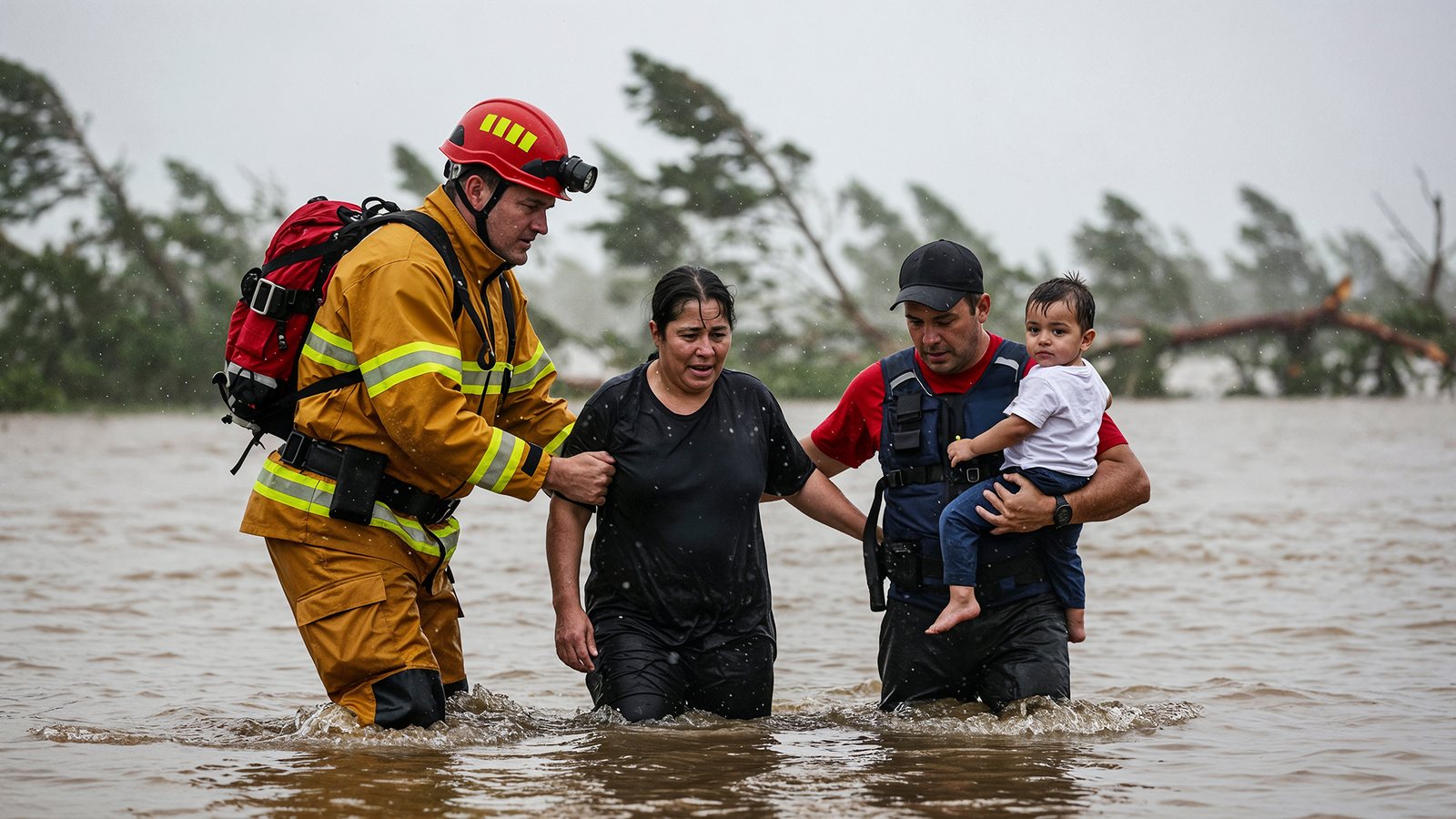
In the last seven days, the United States did not have a flood. It had at least three, in three different regions, from three different storm systems, and the rescuers who answered were the same kinds of people in every one of them: sheriff's deputies, firefighters, game wardens, and neighbors with boats.
It started in the Southwest. From October 30 into November 2, Pacific storms broke records across Arizona, Colorado, and New Mexico. Helicopter crews lifted people off rooftops in Sedona as Oak Creek climbed to nearly eighteen feet, a level local officials called unprecedented. The San Juan River at Pagosa Springs, Colorado, crested at 16.81 feet, within a foot of the town's catastrophic 1911 flood mark; a house was swept down the river and into a bridge, and more than 2,000 people were ordered out. More than 100 homes flooded in Camp Verde, Arizona, Tucson crews made a dozen water rescues in a day, and the town of Gisela, on Tonto Creek, was evacuated outright. Two people died in Flagstaff and one in Henderson, Nevada. Arizona declared a statewide emergency, and Colorado's governor declared disaster emergencies in twelve counties.
Then Florida. On Sunday, November 1, parts of Palm Beach County took up to seventeen inches of rain in about six hours. On Monday, November 2, the National Weather Service in Melbourne called what fell on Brevard County a one-in-1,000-year rainfall: 24.69 inches at Grant-Valkaria, roughly 22 inches in Palm Bay, and 11.04 inches in Melbourne, an all-time daily record for a city that has kept records since 1937. A Flash Flood Emergency, the Weather Service's most urgent flood alert, went out that morning. By the end of the day, sheriff's deputies, state wildlife officers, and fire crews had rescued well over 160 people in Brevard County alone, some by airboat and one man by helicopter, lifted from a tree in Crane Creek. Two people died in Palm Bay. As this series reported on November 3, the same system dropped six to ten inches on the Treasure Coast, and Florida's governor declared a state emergency in seven counties. The water is still moving: the Peace River at Arcadia crested above 16 feet on Thursday night, in major flood stage, with up to 60 homes flooded at River Acres, and it is falling only slowly.
And then, overnight last night, the southern Appalachians. Training thunderstorms dropped five to eleven inches on the Georgia-Tennessee line, 11.19 inches of it in under six hours near Blue Ridge. The Toccoa and Ocoee rivers crested at a record 18.05 feet, breaking the flood of record set in 1990. Crews rescued at least 80 people in Fannin County, Georgia, and at least 68 in Polk County, Tennessee, and Georgia's governor declared an emergency in four counties.
None of these places is a hurricane coast in a hurricane. That is the point. Seven days, three regions, and the common thread was not a storm with a name. It was rain, falling faster than the ground, the creeks, and the culverts could take it, on communities that mostly do not have flood insurance.
The "100-year" label is lying to us
After Brevard County, officials reached for the same phrase they always reach for: a 100-year storm, or a 1,000-year one. Those labels do not mean what most people think. A "100-year" rain is not a storm that happens once a century. It is a storm with a one percent chance of happening in any given year, this year included, and it can happen two years in a row.
Worse, the numbers underneath the labels are old. The rainfall statistics engineers use to size culverts, storm drains, and bridges come from NOAA's Atlas 14, built region by region between roughly 2000 and 2018 out of historical records, on the assumption that the climate of the past predicts the climate of the future. FEMA's flood maps, which decide who must buy flood insurance and who is told they are safe, rest on the same aging foundation, and many of those maps are more than a decade old. NOAA is now rolling out Atlas 15, the first version to factor a changing climate into the official numbers. Until local codes and maps catch up, we will keep building for the rain of the last century and being surprised by the rain of this one.
The second disaster is the insurance gap
When the water drops, the rescues end and the bills arrive, and this is where the week's real damage will be done. A standard homeowners policy does not cover flood. Flood coverage is a separate policy, and almost nobody has one. FEMA estimates that only about four percent of American homeowners carry flood insurance. The federal program's own rolls are shrinking: the National Flood Insurance Program had 4.45 million policies in force this August, down eight percent since 2022 as premiums rose under risk-based pricing. A Federal Reserve Bank of Philadelphia study estimates that about seventy percent of expected annual flood losses to single-family homes, roughly $17 billion a year, are uninsured.
The cruelest part of the map is where the water went. Roughly forty percent of NFIP claims come from outside the government's high-risk flood zones, and about seventy-seven percent of at-risk homes outside those zones carry no flood insurance at all. Tennessee, where Polk County rescuers went into the water last night, has flood insurance on fewer than one home in a hundred statewide. These are not people who ignored a warning label. Most of them were told, by a map, that they did not need the product. FEMA's own figure is that one inch of water in a home causes about $25,000 in damage. The average flood claim pays out around $66,000. An uninsured family does not get a smaller version of that bill. They get all of it.
What would actually change the outcome
None of this is unfixable, and the fixes are not mysterious.
Design for the rain we get now. Adopt the Atlas 15 numbers into building codes, road standards, and stormwater rules as fast as NOAA publishes them, and update flood maps on a cycle measured in years, not decades.
Tell people their real risk before they buy. Flood history and flood risk should be disclosed at every home sale and lease signing, in every state, in plain language.
Stop adding exposure, and retire the worst of it. Steer new building away from the places that flood repeatedly, require new construction to sit higher than the minimum, and fund buyouts and elevations for the homes that flood again and again. The money exists: FEMA's Flood Mitigation Assistance program has $400 million open right now, with applications due February 26, 2027. But as this series documented in "The Backstop, Rebuilt," the flagship mitigation program spent a year in limbo with about $2.2 billion in community projects waiting. Announced money that takes years to arrive does not lift a single house.
Close the insurance gap like we mean it. Keep policies continuous instead of letting them lapse between closings, make the offer of flood coverage automatic and explicit for every mortgage, and keep an affordable option in the program for the low-income families who are the most underinsured of all.
Fund the rescuers before the rain. This week's rescues were performed by county swift-water teams, sheriff's high-water vehicles, state wildlife officers, and, in Georgia, Army Rangers and game wardens. That capacity is local, and it is the only reason the death tolls stayed low. It should be budgeted like the front-line service it is.
And the cheapest fix of all: stay out of the water. People die in vehicles in floods like these, including a Palm Bay man found in his truck this week. Six inches of moving water can knock an adult down. A foot of it can float a car. Turn around, don't drown is not a slogan. It is the whole lesson of the last seven days, learned one rescue at a time.
Where to find help
If you or your community need help with disaster relief, recovery, or preparedness, you can find solutions at R3sults.com and R3sults.org. If your home flooded, document everything before you clean up, and check whether a federal or state assistance program opens for your county. Reach him at hv.tremble@r3sults.com or by phone: Business +1 954-231-1750, Mobile +1 347-874-6296.
Available for consultations, operational support, crisis problem-solving, public speaking, and podcast appearances. Serving all tiers of government, commercial enterprises, and residential communities in disaster relief management and preparedness. From local community planning to large-scale federal response: no job is too big or too small.
Sources
National Weather Service Melbourne, storm summary and rainfall totals, November 1–3, 2026; FOX Weather and Florida Today, Brevard County flooding and rescue reporting, November 2–5, 2026. FOX Weather, Georgia-Tennessee Flash Flood Emergency reporting, November 5, 2026 (Fannin and Polk County rescue figures, Toccoa River record crest, Georgia emergency declaration). Associated Press, CNN, AZFamily, and The Weather Channel, Southwest flooding coverage, October 30 – November 2, 2026 (Sedona, Pagosa Springs, Camp Verde, Gisela, Tucson). NOAA, "Update to U.S. precipitation frequency standards now accounts for climate trends" (Atlas 15). National Weather Service, precipitation frequency and flood safety guidance (100-year definition; Turn Around Don't Drown). MoneyGeek analysis of NFIP policy data, August 31, 2026 (4.45 million policies in force; state penetration rates). Federal Reserve Bank of Philadelphia / Neptune Flood research (roughly 70 percent of expected annual flood losses uninsured, about $17.1 billion). FEMA flood damage and NFIP claims reporting (one inch of water, about $25,000 in damage; average claim about $66,000; roughly four percent of homeowners carry flood insurance).